June 2026
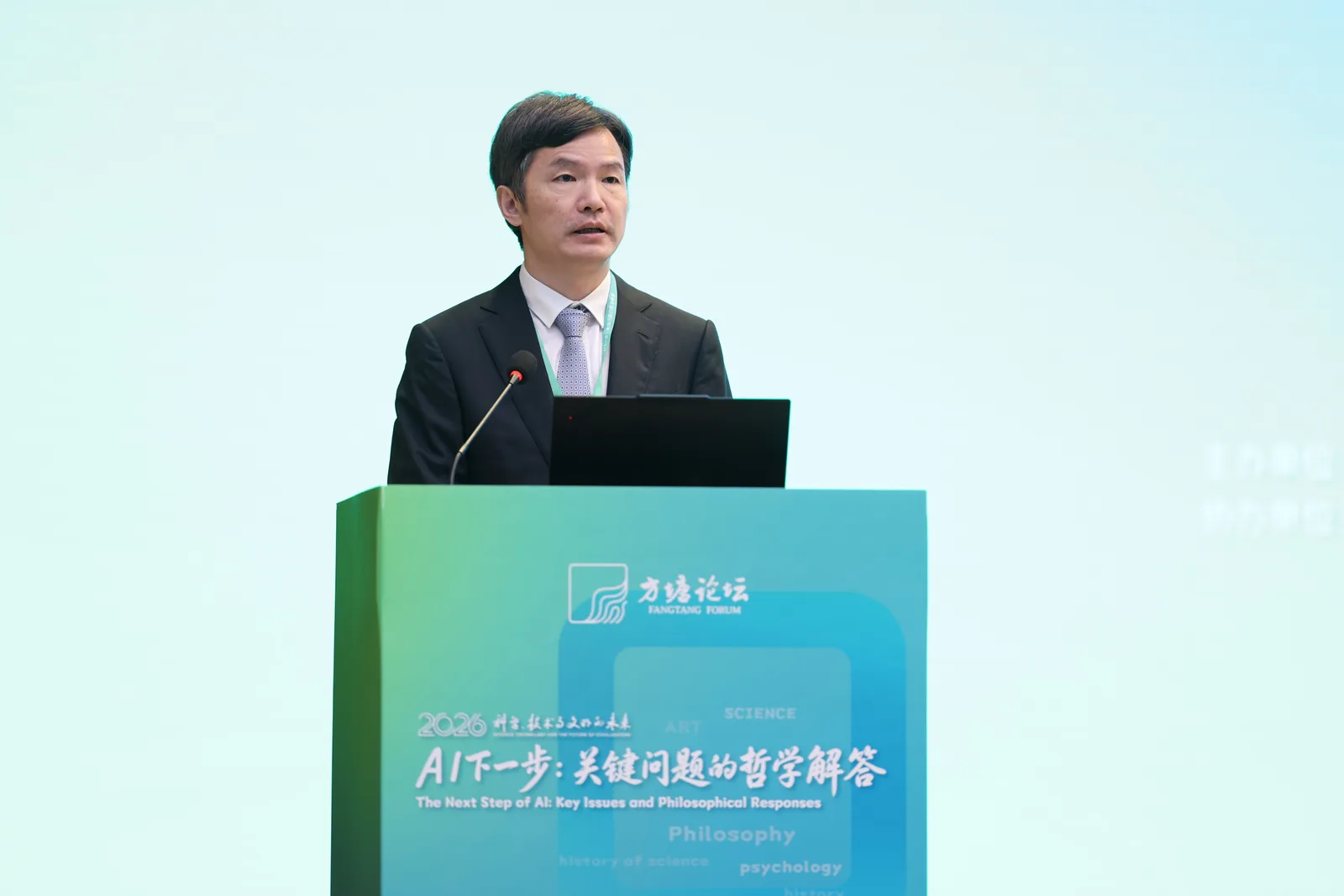
This is an address by Yang Jinfang, a member of the Governing Committee of the Fangtang Research Fund, at the 2026 Fangtang Forum. Taking the “Fangtang Questions” as its thread, it explains the origins of this year’s forum themes and the directions of Fangtang’s inquiry. It also looks ahead: we may be standing at the threshold of a new axial age, and genuine breakthrough may arise from the new intellectual space opened by collaboration between people and machines.
Distinguished teachers and friends, good morning.
It is a pleasure to gather with you at the second Fangtang Annual Forum. Only a year has passed, yet the speed of technological change can make it feel as though we inhabit a different age. In a time of intense change and densely layered challenges, there is another choice besides rushing to respond: to pause, take stock, and formulate the questions that are not yet fully formed but must be faced seriously.
To take questions as a vessel and travel deeply into the future: this is the original aspiration of the Fangtang Questions.
This year marks the seventieth anniversary of the 1956 Dartmouth Conference. Seventy years ago, a group of scientists gathered to pose a question whose influence continues to this day: can a machine possess intelligence akin to that of a human being? The development of AI over the following decades has continually responded to that question.
Today, however, as AI enters knowledge production, social organization, and everyday life, we face more than the question of whether machines can think. A further question has emerged: how should we understand the relationship between people and this powerful presence that we cannot fully comprehend? Will humanity’s place in the universe change? How will relations among people change? This is the first layer of the Fangtang Questions, and it was the subject of the first Fangtang Forum: “The Ethical Singularity in the AI Age.”
Following this inquiry, this year’s forum arrives at a more urgent question: in a post-work age, how will people find a secure basis for life?
This is not merely a question of employment. Modern society has long defined identity, value, and social position through work. If AI can perform more and more kinds of work, will human meaning still rest on being “useful”? Will creation, learning, relationships, responsibility, public participation, and spiritual growth once again become the grounds of human existence?
This is a major subject of this year’s forum and a central humanistic question of the AI age.
AI is also changing how humanity comes to know the world. Increasingly, people understand the world through information organized by AI. Search, translation, summarization, reasoning, and writing: AI is participating in the entire process through which knowledge takes shape. We must ask how AI-generated knowledge can be trustworthy; what new place human understanding occupies when AI participates in reasoning; and whether AI is a tool, an intermediary, or a new environment of knowing.
For this reason, the forum has included discussions on AI epistemology. The real question is no longer whether AI knows, but how human beings can come to know the world anew once AI has entered the process of knowing.
Following epistemology further leads to one of this forum’s central themes: AI for Humanity. AI for Humanity does not simply mean using AI to improve research efficiency. More importantly, it calls for paradigm innovation and the reorganization of humanistic scholarship in the AI age.
AI can of course help us process materials, organize literature, and analyse texts. But the more important question is whether it can participate in discovering questions, generating concepts, organizing knowledge, and making interdisciplinary connections. How will it change the methods, norms, and communities of scholarly research?
I am pleased to see the Fangtang Institute host this year’s AI4H global essay competition, the first of its kind to treat the quality of human-machine collaboration, paradigm innovation, and reflection as important assessment criteria. It can bring together people who truly care about this question and explore new possibilities for knowledge production in the humanities in the AI age.
When AI begins to participate deeply in knowledge production, a new set of questions follows. What norms and standards of evaluation are needed? What constitutes honest human-machine collaboration? What counts as an original contribution? How should contributions by AI and people be distinguished and attributed? How should peer review approach research produced with AI participation? How can scholarly trust be rebuilt?
These questions cannot be resolved by individual self-discipline alone. They require sustained discussion within a community and the gradual formation of new normative frameworks. Fangtang has raised these questions and hopes to participate in shaping corresponding norms. By next year’s forum, we hope to have some initial frameworks available for discussion.
If we follow this chain of questions still further, we return to a broader judgment. At the founding of the Fangtang Institute, I proposed that we may be entering a new axial age.
If that judgment is correct, the deeper question is what form a breakthrough in this new axial age might take. My view is that it may be related to the expansion of human intellectual capacity made possible by human-machine collaboration.
As an unprecedented external cognitive system, AI is helping humanity enter a larger conceptual space. It can connect distant fields of knowledge, reveal hidden structural relationships, and accelerate the unfolding and reorganization of complex problems. This suggests that human thought itself may reach a new dimension.
Large bodies of knowledge, cross-civilizational experience, and interdisciplinary relationships that were once difficult to process together are becoming more amenable to organization and understanding. We have an opportunity to form intellectual structures with greater explanatory power and to make finer, more responsible value judgments.
An important breakthrough of the new axial age, then, may not be a single system proposed by a solitary genius. It may be a substantial increase, through human-machine collaboration, in the complexity that human thought can bear: enabling us to explain a more complex world, make more nuanced value judgments, and assume responsibility in more reasonable ways.
This may be the most important new possibility for humanistic thought in the AI age. AI opens a larger intellectual space in which people can learn anew how to judge, choose, and take responsibility. For what is truly scarce in the AI age is not answers but questions; not speed but judgment; not tools but intellectual structures able to bear complexity.
On this basis, I strongly support Fangtang’s sustained investment in AI for Humanity in the years ahead: defining frameworks for questions, producing high-quality demonstrations, establishing norms and evaluation standards, organizing a community of genuine practitioners, and gradually building question banks, case banks, and networks of thought. The AI age does not lack answers; it lacks questions worth pursuing and judgments that can be trusted. I hope Fangtang will raise real questions, connect people genuinely willing to pursue them, and move those questions toward deeper thought, clearer norms, and more trustworthy communities.
Seventy years ago, the Dartmouth Conference helped inaugurate the age of artificial intelligence. Standing seventy years later, we may not know where the future will lead. But we know that some questions must be pursued now, and that these very inquiries can open a path toward new directions for civilization.
May this forum become a starting point for the Fangtang Questions to continue their journey into greater depth.