June 2025
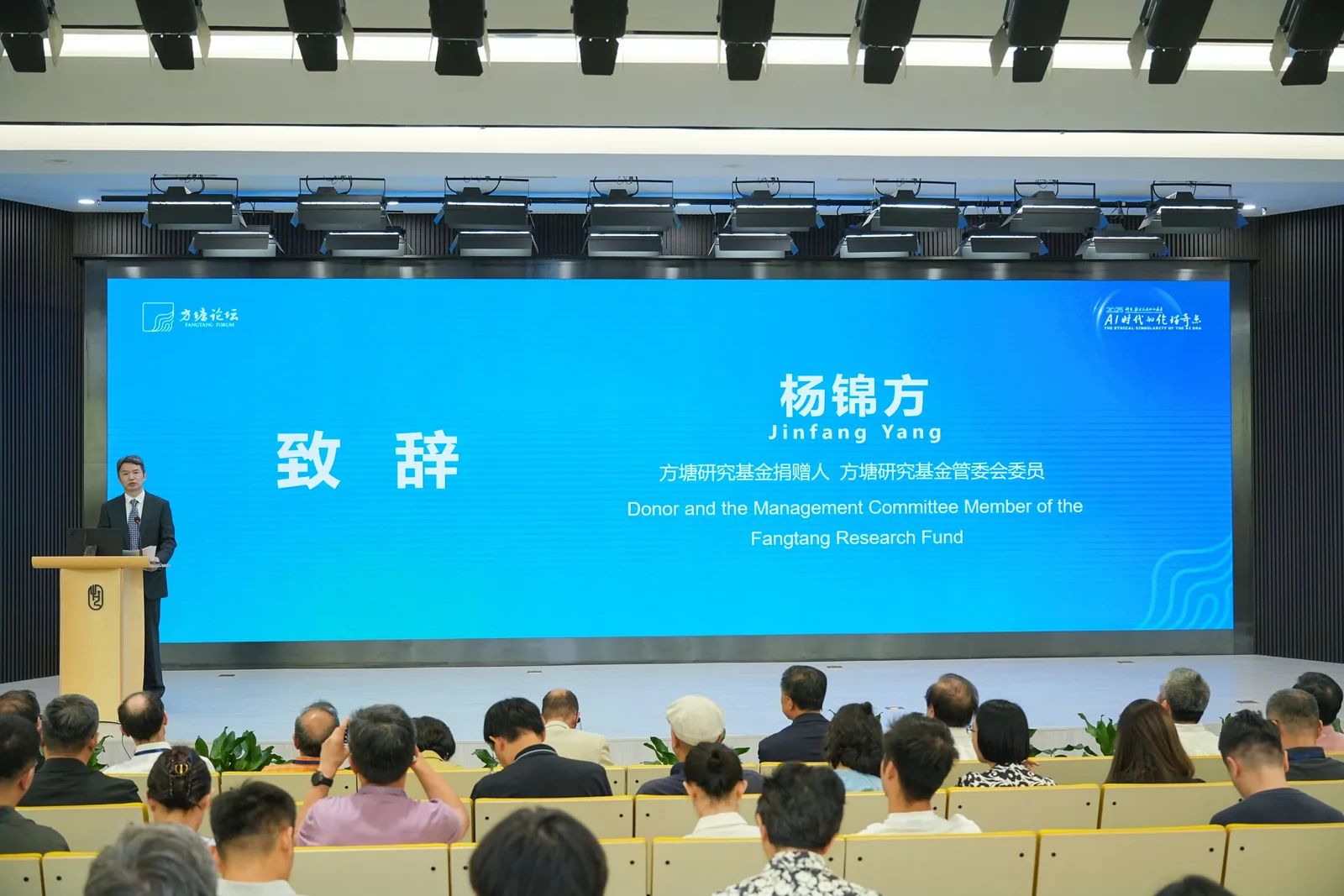
This is Yang Jinfang’s opening address at the inaugural Fangtang Forum on June 23, 2025. Before the forum began, he set out Fangtang’s initial thinking on philosophical and humanistic questions in the AI age, and underscored the urgency of humanistic reflection in an era of great uncertainty.
In this summer season, we gather at Tsinghua to begin a feast of ideas on “Science, Technology, and the Future of Civilization.”
Today is a special day: June 23 is the birthday of Alan Turing, the renowned British mathematician, logician, and computer scientist. Often called the father of computer science and artificial intelligence, Turing laid the foundations of computing and foreshadowed the prominence of AI today. His spirit of inquiry and his vision of the future remain precious intellectual resources for us.
From its inception, the Fangtang Institute at Tsinghua University has taken as its task the creation of a place for the exploration of ideas. With a spirit of reform and openness, it seeks to foster a culture of innovation, enrich the soil in which innovation takes root, and promote deep intellectual exchange across fields. Through a shared “scholarly aesthetic sensibility toward people, problems, and methods,” the Institute aims to convene leading scholars from around the world who uphold pure academic ideals and persist in the pursuit of first-rate theoretical achievements. It seeks to build a new scholarly ecology, advance breakthroughs at the frontiers of the humanities and sciences, and offer intellectual guidance as humanity enters the age of artificial intelligence.
The theme of this forum is “The Ethical Singularity in the AI Age.” I believe everyone here has sensed that a new era is arriving with great force. We stand at a new watershed in human civilization and may well be witnessing the arrival of another axial age in history.
The rapid development of AI has brought humanity into another era of profound uncertainty. Existing work may be displaced on a large scale; intelligent agents and robots may become carers, companions, and friends; and augmented humans and digital immortality may become realities. Philosophy, religion, and ethics will once more become urgent public concerns. AI is changing not only technical applications, but also human cognition, ethics, and social relations, giving rise to new philosophical questions. The age is making an urgent call for the emergence of major new ideas.
Never before has an era brought the future into the present as rapidly as the AI age. In the past, people derived ethical principles from existing experience; the rapid development of AI now compels us to think ahead of our time. Before we can analyse and respond effectively to accelerating uncertainties and unprecedented phenomena, our first challenge is to describe, understand, and grasp the problems themselves with precision. Which concepts and facts must be clarified to make real communication possible? Do we possess adequate conceptual tools? Can we move beyond knowledge and thought built around human experience, and redefine such core concepts as intelligence, consciousness, understanding, and subjectivity? Behind these questions lies a sweeping cognitive revolution and a profound inquiry into existence.
Colleagues, the ethical questions of the AI age are, at their core, humanity’s renewed reflection on its own civilization. When we discuss the relationship between people and AI, we reflect on humanity’s place in the universe; when we discuss algorithmic fairness, we ask what justice is; when we devise moral principles for robots, we reconsider what it means to be human. How will AI reshape every aspect of human life? How will it affect existing social orders and ethical traditions, and how should we respond? The answers concern every person and every community. For millennia, the question of how people may find a secure basis for life has been central in Chinese thought. It touches every level of human need and the practical arrangement of individuals and groups in social structures. A systematic inquiry into how human beings may find such a basis in the AI age will surely be among humanity’s most universal concerns: it has scholarly value and existential value, and carries both urgency and anxiety as well as hope and anticipation.
Although the importance of AI ethics is now globally recognized, much remains to be done to enable effective research. Scientists, technical experts, and humanists need to align their understanding of key facts and basic concepts; inherited disciplinary divisions and self-definitions, whether in research agendas or boundaries of responsibility, need to be surpassed; and dialogue and collaboration across disciplines, cultures, and traditions need to deepen. This is why we have initiated this forum: to bring philosophers, AI experts, science-fiction writers, and thoughtful people from around the world together, break through disciplinary and geographical boundaries, discuss the great questions concerning the future of human civilization, and nurture scholarly theories oriented toward the future.
Looking ahead, the Fangtang Institute will continue to support frontier scholarship in AI ethics, foster an open, inclusive, and dynamic research ecology, and help establish a Chinese and global center for frontier research in the humanities in the AI age. We believe that every guest here will bring a distinctive contribution to this undertaking.
Let us face technology with humility, safeguard the humanities with reverence, and define the future with initiative. May the Fangtang Forum gather the living waters at the source of thought. I wish this forum every success.